
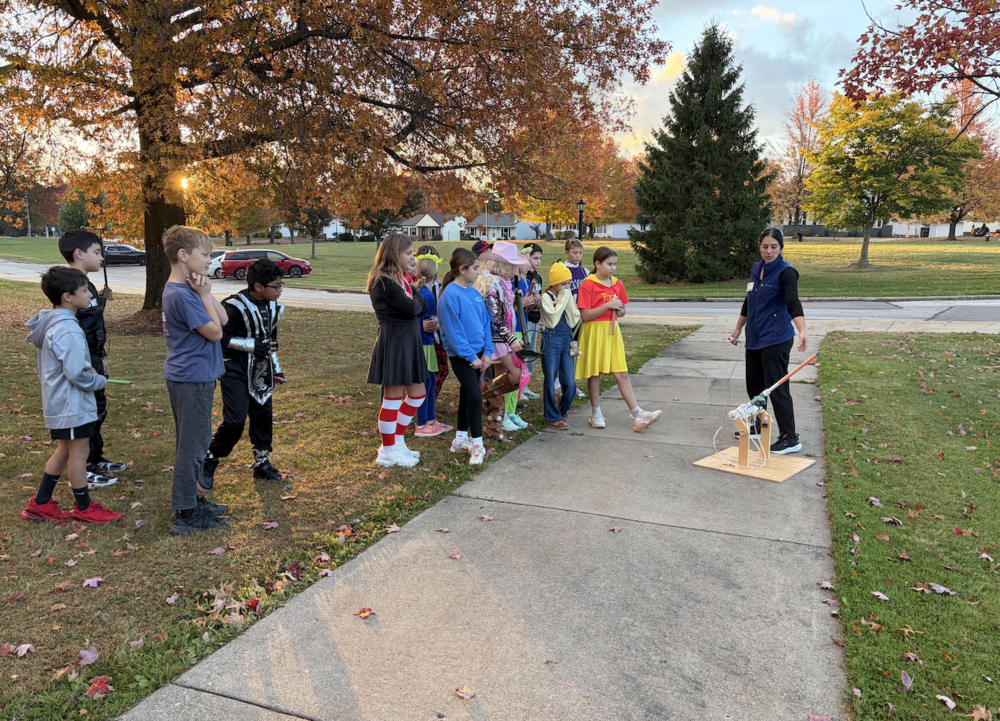
Fifth-grade students at Independence Middle School put their knowledge of forces, motion and energy to the test on October 30 when a representative from MAGNET (Manufacturing Advocacy and Growth Network) visited science teacher Lily Vucenovic’s classes for a hands-on rocket-building and launching experience.
Working in pairs and small groups, students designed and constructed rockets using construction paper, masking tape, hot glue and 3D-printed nose caps. Once their rockets were assembled, students headed outside to test their designs using a compressed-air launcher powered by a bicycle pump.
With each launch, students watched their rockets soar as high as 100 feet into the air.
The activity connected directly to Ohio’s fifth-grade physical science standards on force, motion and energy. Students explored how compressed air creates the force needed to propel a rocket upward, how gravity brings it back to the ground and how kinetic and potential energy change throughout the flight.
Beyond launching rockets, students put their problem-solving skills to work. They considered how weight distribution, aerodynamic design and tight paper seals could affect their rockets’ performance. Students predicted how high their rockets might travel, tested their designs and made adjustments to address challenges such as air leaks and flight stability.
The MAGNET representative guided students through the building and launching process while introducing them to manufacturing, engineering and aerospace technology in Northeast Ohio. The experience helped students see how the scientific concepts they study in the classroom connect to real-world industries and careers.
For Vucenovic, the activity provided an opportunity to make scientific principles more meaningful through firsthand experience. Rather than simply reading about forces and motion, students could observe how changes in design and air pressure affected their rockets’ flight.
The experience also encouraged teamwork, creativity and perseverance as students worked together to solve problems and celebrated successful launches.
Vucenovic hopes the activity will inspire students to remain curious about how things are designed and engineered while developing confidence in their ability to solve problems through trial and error.
Students will continue building on their understanding of forces, motion and energy in upcoming science lessons, using their rocket-launching experience as a foundation for further exploration.